The Grease Trap: Why Your Hair Feels Oily and Brittle at the Same Time
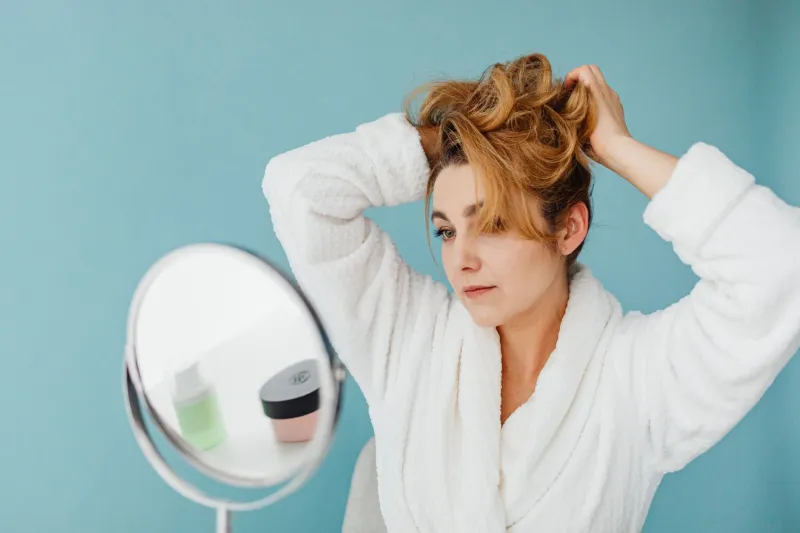
Your roots are gleaming by lunch. Your ends feel like a broom that has seen things. So you buy a clarifying shampoo, then a deep conditioner, then a bond builder, and somehow your hair still acts like it is sending two different group chats. Same. The issue is usually not that your hair is simply "oily." It is that your scalp and your strands are asking for different things — and the product aisle is not exactly known for being clear about that.
The misdiagnosis hiding in plain sight
Hair does not produce oil. Your scalp does. Sebum travels down the strand, and depending on your hair texture, density, and wash routine, it can make the top half look greasy while the bottom half stays dry. Add hard water, heat styling, leftover leave-in, dry shampoo buildup, or a color service, and you get the classic combo: slick at the roots, crunchy at the ends.
That is not one hair type. That is a scalp issue plus a strand issue. And before you decide your hair is "too oily" or "too dry," you need to figure out whether your strands are actually unbalanced in protein and moisture — or whether you are just layering too many products and calling it a routine.
The five-minute stretch test (no tools, no salon)
This is not a lab test. It is a rough but useful clue. Wait until your hair is clean and dry, then pull a shed strand from your brush — one with a little length, not a tiny broken piece. Wet it with tap water. Hold each end and gently stretch it. Let go.
- Snaps almost immediately, with barely any stretch: Your hair is acting brittle. That can point to too much protein, damage, or both. It usually needs moisture and a break from protein-heavy products.
- Stretches like a gummy candy and does not bounce back: That is the mushy zone. It often means moisture overload, and your hair may need a protein treatment to help it hold shape.
- Stretches a little, then springs back: That is the balanced zone. If your roots are still greasy, your problem is probably scalp oil, buildup, or your wash technique — not a protein-moisture crisis.
Try three to five strands from different areas, because your roots and ends can behave differently. One strand is a hint, not a diagnosis. If you have itching, flaking, or sudden thinning, skip the internet test and see a dermatologist.
The symptom decoder
Here is the zero-gatekeeping translation guide:
- Greasy roots, rough ends: Your scalp is doing normal scalp things, but your ends are thirsty or coated in buildup. Shampoo the scalp, condition the ends, and clarify occasionally instead of washing the whole head into oblivion.
- Limp, mushy hair when wet: This is the moisture-overload stereotype. Your hair may stretch too much and feel soft in a weird, weak way. Add a mild protein treatment, then follow with conditioner.
- Straw texture, snapping, rough cuticle: This is the protein-overload stereotype. Your hair may feel stiff and break easily. Pause the protein masks and lean into moisture.
- Flaky, itchy, oily scalp: That is a scalp conversation, not a hair-type conversation. Try a dandruff or clarifying shampoo as directed, and get professional help if it persists.
- Product pilling or white flakes: You are probably layering too much. Oils, silicones, and leave-ins can fight each other. Clarify, then simplify.
Read the label like a person, not a chemist
You do not need a science degree to spot the main characters. You just need to know what job they are doing.
- Proteins: Look for hydrolyzed wheat, rice, soy, silk, or keratin protein, plus amino acids and collagen. These can help hair feel stronger, but if your hair is already snapping, more protein is not automatically better.
- Moisture magnets: Glycerin, honey, panthenol, aloe, and hyaluronic acid pull in water. Great in humidity, sometimes tricky in dry winter air unless you seal them in.
- Emollients and sealants: Oils, shea butter, and dimethicone coat the strand and slow water loss. They can also build up if you use them on repeat without washing properly.
- Clarifiers: Sulfates are not villains. They are tools. If your hair feels coated and limp, a clarifying wash every couple of weeks can reset the whole situation.
- Bond builders: These are not the same as protein or moisture. They are a separate lane. Do not stack them with everything else and expect your hair to send a thank-you note.
Ingredient order matters, but it is not the whole story. A product can list protein near the bottom and still be fine. The real question is what your hair is doing right now — and whether you are adding more of the same thing that caused the problem.
Fix the routine before you fix the cart
Once you have a clue, change one thing at a time. Wash your scalp, not your ends, and let conditioner do the heavy lifting from mid-length down. If your hair feels mushy, use a protein mask, then a moisturizing conditioner. If it feels straw-like, skip protein for two weeks and focus on moisture. Clarify when you have buildup, not because a label told you to. And stop layering three leave-ins on damp hair unless you enjoy the feeling of mystery residue.
Your hair is not confused. Your routine is. Run the stretch test, read the first five ingredients, and give your hair two weeks to respond before you buy another bottle in 2026. The goal is not a shelf full of maybe. The goal is knowing what your hair actually needs.